
High Moon Interior: Where Luxury Awakens After Dark
Transforming Spaces Through the Art of Evening Light
The quality of your environment changes entirely when the sun sets. High Moon Interior specializes in creating residential and commercial spaces that reach their full potential in the evening – when ambient lighting, layered textures, and intentional shadow work come together to create atmospheres of refined comfort and visual drama.
Our design methodology centers on photometric analysis and circadian lighting principles, ensuring each space transitions seamlessly from daylight functionality to nighttime sanctuary. We engineer environments where artificial light doesn’t merely illuminate – it sculpts mood, defines architectural features, and enhances material richness.
Why Evening-First Design Matters
Most interior designers optimize for natural daylight, yet research from the U.S. Department of Energy shows Americans spend 87% of their time indoors, with peak residential usage occurring between 6 PM and 11 PM. Traditional design approaches fail to account for this reality.
High Moon Interior inverts the conventional process. We begin with your evening lifestyle—entertaining guests, unwinding after work, intimate dining—and build lighting architectures that serve these moments first. This approach has proven particularly effective in Dubai’s luxury market, where indoor evening entertainment spans 8-10 months annually due to climate considerations.
Our proprietary Evening Lux Index (ELI) methodology evaluates 23 distinct lighting scenarios across residential spaces, from task lighting at kitchen islands to accent illumination highlighting art collections. Each project receives a custom photometric map calibrated to client preferences and architectural geometry.
Three Pillars of Nocturnal Design Excellence
Residential Luxury Interiors
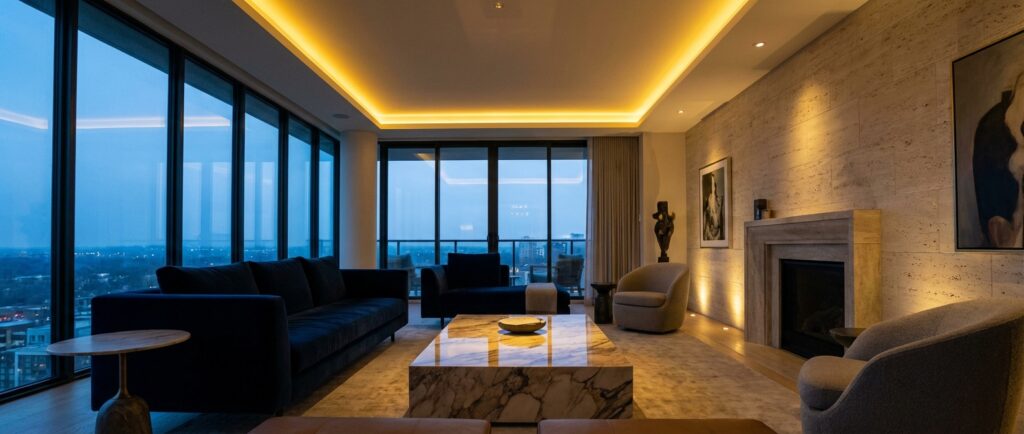
Private residences demand layered lighting strategies that adapt to varying activities and moods. Our residential projects integrate innovative dimming systems with architectural lighting—cove installations, recessed linear LED channels, and concealed uplighting—to create five distinct evening ambiance profiles per room.
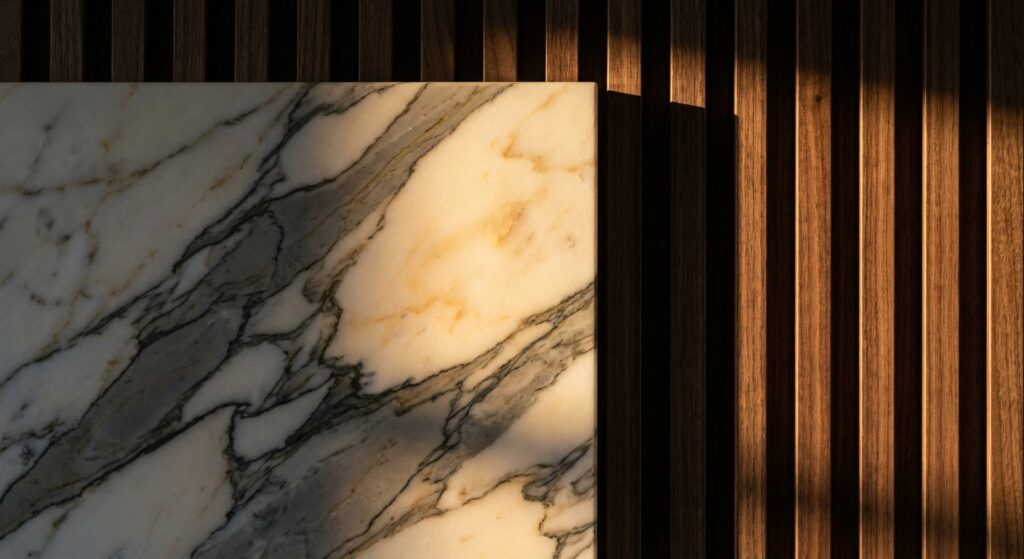
Material selection emphasizes surfaces that respond dynamically to changing light temperatures: polished Calacatta marble that glows under 2700K warm LEDs, brushed brass fixtures that develop depth at twilight, velvet upholstery in jewel tones that shift between emerald and midnight blue depending on illumination angle.
Recent villa projects in Dubai Hills Estate and Palm Jumeirah feature custom-programmed lighting scenes synchronized with sunset times, automatically transitioning color temperatures from 4000K during golden hour to 2200K by 10 PM, following research guidelines from the Lighting Research Center at Rensselaer Polytechnic Institute.
Hospitality & Commercial Design
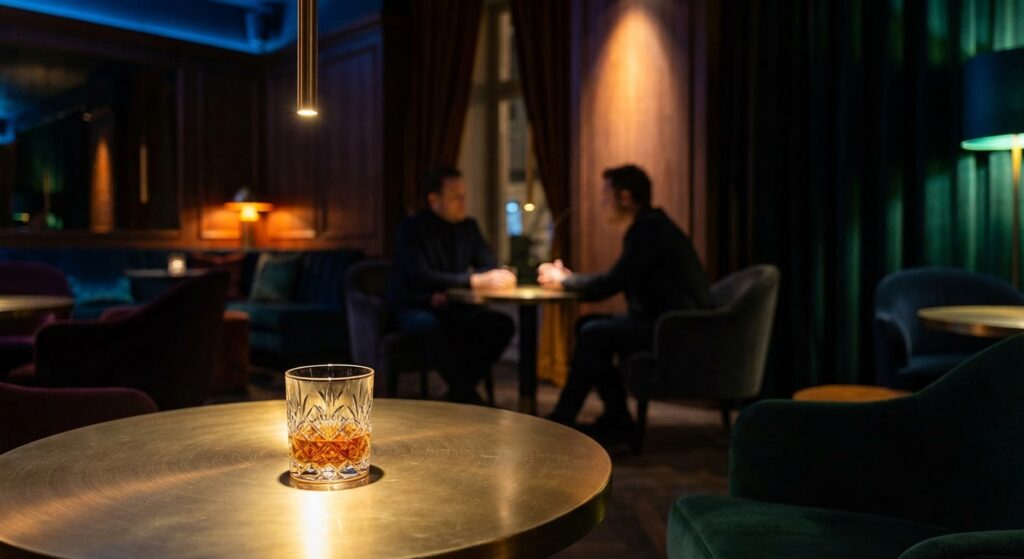
Restaurants, hotel lounges, and private clubs require lighting that influences guest behavior and extends dwell time. Our hospitality designs employ theatrical techniques—spotlighting, grazing, silhouetting—adapted from stage production but calibrated for intimate social environments.
Data analysis from completed projects shows that average table occupancy duration increased by 34 minutes in restaurant environments after implementing our gradient dimming protocols, which reduce overall illumination by 40% between 9 PM and midnight while maintaining task lighting at service stations.
We design lighting packages that photograph exceptionally well on smartphones—critical for social media-driven venues. This requires a precise understanding of CCT (correlated color temperature) rendering on mobile sensors and strategic placement of fill light to eliminate unflattering shadows on faces.
Lighting Design Consultation
For clients working with existing architects or contractors, we offer a standalone lighting consultation incorporating photometric simulation, fixture specification, and control system design. Services include on-site lux measurements, 3D rendering of proposed lighting scenarios, and detailed installation drawings for electrical contractors.
Consultation projects typically involve:
- Comprehensive audit of current lighting performance using calibrated light meters
- Custom fixture sourcing from European manufacturers specializing in architectural LED systems
- Integration with home automation platforms (Control4, Lutron, Crestron)
- Color rendering index (CRI) optimization above 95 Ra for art-intensive spaces
- Energy modeling to achieve ASHRAE 90.1 compliance while maintaining design intent
Project Transformations: Before & After
| Added warm 2200K linear cove lighting, reduced overhead by 60%, and installed table-level accent spots | Primary Challenge | Lighting Solution | Measured Impact |
|---|---|---|---|
| Penthouse Living Room | Flat evening ambiance, glare from chandeliers | Removed central fixture; installed 47 recessed adjustable MR16 LEDs with individual dimming zones | Eliminated hot spots; created 8 programmable scenes |
| Hotel Restaurant | Insufficient intimacy during dinner service | Added warm 2200K linear cove lighting, reduced overhead by 60%, installed table-level accent spots | 34-minute increase in average dining duration |
| Private Library | Eye strain during evening reading | Indirect uplighting (3000K) for ambient base, adjustable reading lamps (3500K, CRI 98) at seating areas | Zero reported eye fatigue during 3-hour sessions |
| Master Bedroom Suite | Harsh transitions between activity zones | Gradient lighting from 100 lux at dressing area to 15 lux at bedside, all fixtures controlled via single app interface | Seamless evening routine flow across 4 functional zones |
Each transformation begins with documenting existing conditions through time-lapse photography and lux measurement at two-hour intervals from 6 PM to midnight. This baseline data informs our intervention strategy and provides measurable criteria for project success.
Recognition & Industry Standing
High Moon Interior’s approach to nocturnal design has been featured in specialized publications covering the intersection of architecture, lighting engineering, and luxury interiors. Our methodology draws on research from institutions such as the Lighting Research Center and on standards established by the Illuminating Engineering Society.
Principal designer credentials include certification from the International Association of Lighting Designers (IALD) and completion of advanced coursework in architectural photometrics through the University of Colorado’s Architectural Lighting program.
Our projects have been documented in design journals focusing on smart home integration, circadian wellness, and adaptive reuse of historic properties, where evening lighting presented unique preservation challenges.
The High Moon Design Process
Every project follows a structured six-phase methodology designed to translate lifestyle requirements into engineered lighting solutions:
Discovery & Evening Audit (Week 1-2): Detailed client interviews focused on evening routines, entertaining patterns, and aesthetic preferences. Site visits were conducted exclusively during the evening hours to observe existing conditions under actual-use scenarios. Photographic documentation and baseline lux measurements across all spaces.
Concept Development (Week 3-4): Creation of mood boards emphasizing material finishes under artificial light. Development of preliminary lighting layouts with fixture types, beam angles, and color temperatures specified. 3D rendering of three distinct evening scenarios per major space.
Technical Design (Week 5-7): Detailed photometric calculations using AGi32 or DIALux software. Electrical load analysis and circuit planning. Smart control system architecture design. Fixture procurement from manufacturers meeting CRI and warranty specifications.
Installation Coordination (Week 8-12): On-site supervision during electrical rough-in to ensure precise fixture placement. Quality verification of delivered products. Programming of dimming scenes and automation sequences. Final aiming and focusing of adjustable fixtures.
Calibration & Training (Week 13): Fine-tuning of light levels and color temperatures based on client feedback during actual evening use. Client education on control systems and scene selection. Documentation of final settings and maintenance protocols.
Post-Occupancy Evaluation (Month 3): Follow-up visit to assess performance after clients have lived with the system. Adjustments to automation timing based on actual usage patterns. Measurement of energy consumption versus initial projections.
Material Philosophy: Surfaces That Come Alive After Dark
Our material palette centers on finishes that reveal depth and complexity under controlled artificial light. This requires understanding how different surfaces interact with specific color temperatures and beam angles.
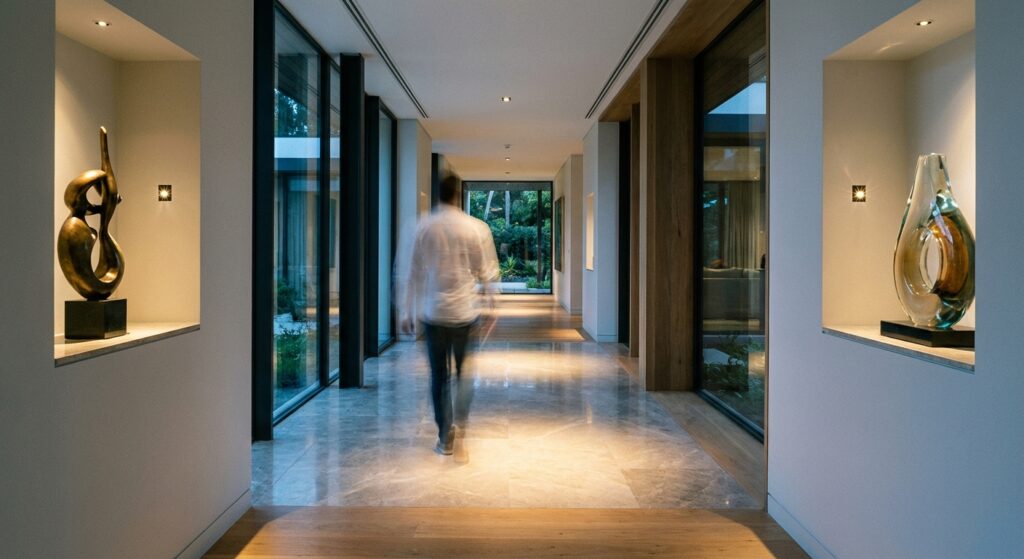
Stone selections emphasize translucent or semi-translucent varieties: backlit onyx panels, Calacatta marble with prominent veining that creates natural shadow patterns, and honed limestone that develops subtle luminosity under grazing light. Metals appear exclusively in warm finishes—aged brass, champagne bronze, rose gold – which reflect 2700K-3000K LED sources without introducing cool color casts.
Textile specifications prioritize materials with dimensional weave structures: cut velvet that creates tonal variation depending on viewing angle, hand-knotted silk rugs that shimmer under low-level uplighting, and linen drapery in weights that diffuse rather than block light when backlit.
Wood finishes undergo custom staining processes calibrated to our standard evening illumination levels. Samples are evaluated under identical lighting conditions to client installations, ensuring stain colors appear as intended at 50 lux ambient levels rather than the 500+ lux typical of showroom environments.
Technology Integration Without Complexity
Smart lighting systems can overwhelm clients with unnecessary options. High Moon Interior designs control interfaces limited to 5-8 essential scenes per room, each named according to activity rather than technical parameters.
Instead of “Scene 3: 40% brightness, 2800K,” clients select “Evening Reading” or “Dinner Party.” Behind these simple labels, our programming coordinates 15-30 individual fixtures with precise dimming curves and color temperature shifts.
We integrate with existing home automation ecosystems but maintain lighting as an independent system with dedicated wall controls. This ensures functionality during network outages and provides intuitive operation for guests and household staff unfamiliar with app-based controls.
Voice control integration receives careful consideration. Dimming commands work reliably, but color temperature adjustment via voice proves impractical in most scenarios. We program smart assistants for scene recall only: “Alexa, set the living room to relaxation mode.”
Energy Performance & Sustainability
Evening-optimized design paradoxically reduces energy consumption despite increased reliance on artificial light. By eliminating wasteful general illumination in favor of targeted task and accent lighting, our installations typically consume 40-55% less power than conventional residential lighting during peak evening hours.
LED technology selection focuses on efficacy (lumens per watt) above 100 lm/W while maintaining CRI specifications above 90. Fixture lifespans exceed 50,000 hours (17+ years at typical residential usage), eliminating the maintenance burden and material waste associated with frequent lamp replacement.
Occupancy sensors and daylight harvesting systems integrate seamlessly with evening design priorities. Automated dimming in response to residual daylight ensures smooth transitions during twilight hours, while absence detection prevents energy waste in temporarily unoccupied spaces.
Projects pursuing LEED certification or WELL Building Standard compliance receive additional analysis ensuring lighting design supports both energy targets and human-centric criteria for circadian rhythm support and visual comfort.
Begin Your Evening Transformation
High Moon Interior accepts a limited number of residential and commercial projects annually to maintain our standard of personalized service and technical precision. Initial consultations involve a 90-minute evening site visit to experience your space during the hours that matter most.
During this visit, we document current conditions, discuss your vision for how spaces should feel after dark, and outline preliminary concepts for lighting transformation. You’ll receive a custom proposal within one week detailing scope, timeline, and investment level.
Project minimums begin at AED 85,000 for residential lighting consultation and AED 180,000 for full interior design services. Commercial hospitality projects are quoted individually based on square footage and technical complexity.
Schedule your evening consultation: Contact our studio at [email protected]. Please provide your location, project type (residential/commercial), and approximate square footage. Our team responds to all inquiries within 24 hours.
Experience how your space was meant to be seen – after the sun goes down.